
Is your company’s cash at risk? How a holding company can protect it
If your company is doing well and money is building up in the bank, this is worth five minutes of your time.
The problem: your cash is sitting in the firing line
Most owner-managed businesses start the same way. One company, owned by one or two people, often a husband and wife. Your limited company protects you personally if things go wrong.
As the business grows, you sensibly take out only what you need, to keep your personal tax bill down. So profit, cash and sometimes property build up inside the company.
Here is the catch. If your company is ever sued, and loses, everything inside it could be at risk. That includes the cash you have worked hard to build up.
The solution: a holding company
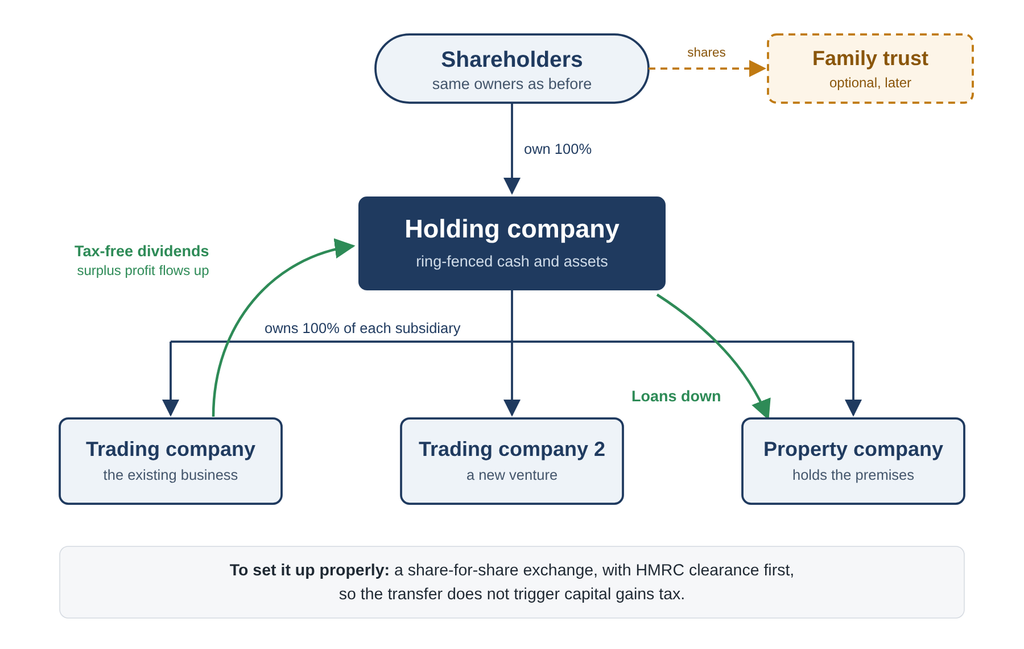
A holding company is a new company that sits above your existing business. Your trading company becomes its “subsidiary”, which simply means a company it owns.
You still own everything. The owners stay exactly the same. It is just a new way of arranging your companies.
Each year, any spare profit your business does not need is passed up to the holding company. Payments like this between your own companies are tax-free. The money is now out of reach if something goes wrong in the trading business. Meanwhile, you carry on paying yourself your salary and dividends exactly as before.
Think of the holding company as a safe. The day-to-day business takes the risks. The safe keeps what you have earned.
Four ways a holding company helps you
1. It protects what you have built
This is the main reason to do it. Your profits are kept apart from the risks of trading.
A real example
An optician had four shops. To save on accountancy fees, he kept everything, the business and all four shop properties, in one company.
One day, someone tripped on the pavement outside one of his shops. The pavement belonged to the council, but his sign was outside, so he was sued. He lost, and it cost him £30,000.
Once someone is suing you, it is usually too late to move money or property around. It can look like you are hiding assets. He had no choice but to see it through. Afterwards, he set up a holding company and moved the properties into their own separate company, so they were protected in future.
It is not just big businesses. Dentists, for example, often build up £200,000 to £300,000 of cash and can face claims from patients. Whatever your size, it makes sense to protect what you are building.
2. It helps you grow without paying extra tax
Say you want to buy a property or start a new business. Normally, you would take money out of your company first and pay income tax on it, often at the higher rate.
With a holding company, profits move up tax-free. The holding company can then lend that money to a new company in the group, also tax-free. You invest more because less goes to tax. And the new venture sits in its own company, so if it struggles, your main business is protected.
3. Losses in one company can reduce tax in another
When your companies are in a group, a loss in one can be set against the profits of another. So if your new venture loses money in its early years, that can cut the tax bill on your main business.
4. You could sell your business tax-free
If your holding company sells one of its trading companies, the sale can be completely tax-free in many cases. This is thanks to a relief called the substantial shareholding exemption. On a £5 million sale, that could mean no tax at all inside the holding company.
There is tax to pay when you take that money out personally. But if you are planning to retire abroad, there may be ways to take it out tax-free over time, as long as you stay overseas for more than five years and follow the rules.
A holding company also makes it easier to pass the business on, split it up, or sell part of it to your management team later.
Warning: calling it a holding company is not enough
This is a very common mistake. Someone sets up a new company, calls it “XYZ Holdings Ltd”, and thinks the job is done. It is not.
To set up a holding company properly you need to:
- swap your shares in the trading company for shares in the new holding company (this is called a “share-for-share exchange”)
- get written agreement from HMRC first that no tax is due on the swap
- have lawyers prepare and sign the paperwork, usually 8 to 10 documents
What happens if you get it wrong
One business owner believed he had a holding company since 2018. When his paperwork was checked, there had been no HMRC agreement and no legal work. All he really had was two separate companies, one of which happened to have “holding company” in its name.
When he came to sell, he could not claim the tax relief he was counting on. It left him around £500,000 worse off.
How it works, step by step
- Plan it. Your adviser works out the steps and checks the tax position, including capital gains tax and stamp duty (0.5% on shares).
- Get HMRC’s agreement. Your adviser writes to HMRC and gets their confirmation in writing before anything happens.
- Make it official. Lawyers prepare the documents, and the share swap happens once everything is signed.
Once your holding company is in place, adding new companies is easy. Any new business you start can be owned by the holding company from day one, with no need to ask HMRC again.
Common questions
If one of my companies goes bust, are the others safe?
Yes. Each company is legally separate, so problems in one do not spread to the others. The exception is if one company has guaranteed the debts of another, so it is worth checking for any guarantees.
My company has around £700,000 in it. Can I use that money elsewhere once the holding company is set up?
Usually, yes. As long as the company has enough profits on its books, it can pass the money up to the holding company. From there it can be moved or lent to another company in the group, with the right paperwork.
Can I start as the only owner and add family members later?
Yes, but get advice first. There may be tax to think about, depending on who you are adding, when, and what the business does.
Can I put shares into a family trust?
Yes, and it can be a good way to plan for the future. But there are inheritance tax rules as well as capital gains tax rules, and you will need your shares valued. A couple can usually put up to £650,000 into a trust with no immediate inheritance tax.
Trading businesses get extra tax reliefs that can help, though business property relief at the full rate now covers only the first £2.5 million. Property companies do not get these reliefs, so it is usually done gradually. Either way, the earlier you start, the more you can do.
I am selling part of my business and might move abroad. How do I get the money out?
Think about this before you sell. Depending on your plans, selling the holding company itself might work better than taking money out later. If you are moving abroad, the UK residence rules matter, and you will probably need advice in your new country too.
Is a holding company right for you?
When you are just starting out, a holding company is not usually needed. The time to think about it is when:
- your business is making good profits
- cash is building up in the company
- you own property, or are thinking of buying some
- you are planning a new venture, or thinking about selling one day
- your industry carries a risk of claims, such as construction, healthcare or retail
If that sounds like you, it is worth a conversation with your accountant, or book a meeting or email Josef@MrBlueski.co.uk for a no-pressure conversation about getting this done for you.
The key points
- Cash in your trading company is at risk if the business is ever sued.
- A holding company keeps your profits safe, and you still own everything.
- Money moves between your companies tax-free, so you can invest and grow more.
- You could sell a business tax-free when the time comes.
- It must be set up properly, with HMRC’s agreement and legal paperwork. A company with “holdings” in its name is not enough.
This article is general information, not tax or legal advice. Everyone’s situation is different, so speak to a qualified adviser before making changes to your business.






One Response